Scheduling the removal of the kube-proxy IPVS backend
The ipvs backend for kube-proxy was an experiment in providing a
service proxy implementation with better performance than the
iptables backend. While it succeeded in that goal, the kernel IPVS
API has turned out to be a bad match for the Kubernetes Services API,
and the ipvs backend was never able to implement all of the edge
cases of Kubernetes Service functionality correctly.
In Kubernetes 1.29, the project introduced the nftables backend for
kube-proxy, which became GA in 1.33. Part of the plan behind adding
the nftables backend was the idea that it would eventually replace
both the iptables and ipvs backends. Because the ipvs backend in
particular is complex, not 100% feature complete, and architecturally
quite different from the other two backends (and thus more work to
maintain), Kubernetes SIG Network decided to officially deprecate it
as of Kubernetes 1.35. Although it currently remains available in
kube-proxy (with a warning about its deprecation), we (Kubernetes SIG
Network) now plan to remove it in Kubernetes 1.40. All ipvs users
should therefore be planning to migrate to either the nftables or
iptables backends.
Why was the ipvs backend written?
The ipvs backend was originally designed to fix two different kinds
of performance problems in the iptables backend:
-
First,
iptableshad problems with data plane latency (the speed at which clients could establish new connections to services), because kube-proxy would write a separate iptables rule to match each service IP, so every new connection would need to be matched against a long series of rules that was O(n) in the number of services in the cluster. -
Second, it had an even larger problem with control plane latency (the speed at which kube-proxy could process changes to services and endpoints and update the data plane rules), because kube-proxy would rewrite the entire iptables ruleset every time any service or endpoint changed. While the list of rules itself was only O(n) in the total number of endpoints, the amount of time, RAM, and CPU that it took to process the updated ruleset grew faster than that. In very large clusters, kube-proxy would use 100% of one CPU all the time just to process iptables updates. (In fact, the control plane scaling problem was bad enough that for most users it was not even possible to grow the cluster to the size where the data plane scaling problem became noticeable.)
The ipvs backend solved both of these scaling problems. The data
plane problem was solved mostly automatically, because the kernel IPVS
subsystem uses hash tables rather than linear lookup. The
control-plane problem was solved by not rewriting the entire
ruleset on every update. (The kernel IPVS API doesn’t have a way of
doing batch updates anyway, so this was essentially forced.)
Why is the ipvs backend now being deprecated?
Almost from the start, the ipvs backend also had problems.
The first version didn’t have 100% compatibility with the iptables
backend, but it was assumed that this would be fixed over time.
Unfortunately, the original authors moved on to other things outside
the Kubernetes ecosystem (as inevitably sometimes happens in open
source), and it took a while to find new people interested in
maintaining the code.
Meanwhile, as people began using the ipvs backend in larger and
larger clusters, its own scaling problems started to emerge. In
particular, the lack of batch update operations in the IPVS API meant
that while the ipvs backend was faster than iptables when making a
few small changes, it was potentially slower when making a large
number of changes at once. And because the IPVS API is fairly limited
in what it can do, kube-proxy's ipvs backend needed to fall back to
using iptables to implement various features of Kubernetes Services
beyond basic "load balancing", making it run into some of the same
scaling problems the iptables backend has. While the ipvs backend
tried to mitigate this by using ipset for some of its rules, this
again ran into the problem of not having a batch update API.
Additionally, the fact that the ipvs backend uses iptables means
that it has the same long-term support problem as the iptables
backend: Red Hat's plan to remove the iptables API entirely from Red
Hat Enterprise Linux means the ipvs kube-proxy backend will also no
longer be available to Kubernetes users on RHEL.
What about IPVS schedulers?
Beyond performance, the other reason some users were excited about the
ipvs backend was the ability to pick from among various IPVS
"schedulers" for distributing traffic to endpoints, rather than
relying on the simple random selection used by iptables (and
nftables).
Unfortunately, the way IPVS is used by kube-proxy prevents it from
being able to use most of the IPVS schedulers in a useful way. The
problem is that kube-proxy is a distributed service that runs on all
nodes in the cluster, but the kube-proxy processes on different nodes
do not share their IPVS scheduler state, so each node picks endpoints
without knowing what is happening with clients on any other node. Even
the schedulers that are designed to work in a distributed way
generally don't work better than random selection in the context of
kube-proxy. For example, the mh scheduler uses Maglev Hashing to
select endpoints, which theoretically allows for extremely efficient
distributed load balancing. But that efficiency is only in the context
of a specific sort of two-layer load-balancer design, and kube-proxy
does not have the right architecture to be able to act as either of
the two layers in that design.
Switching away from ipvs
Switching to nftables
If you are running Kubernetes 1.36 or later, and your nodes are
running a Linux distribution with kernel 5.13 or later, and you use
the ipvs proxy mode, then Kubernetes recommends switching to the
nftables mode of kube-proxy. (Although the nftables backend is GA
—and fully usable—as of Kubernetes 1.33, there have been some
performance- and scaling-related fixes since then that that weren't
backported to releases earlier than 1.36.)
The nftables backend is fully supported, feature-complete, and even
has very slightly better performance than ipvs:
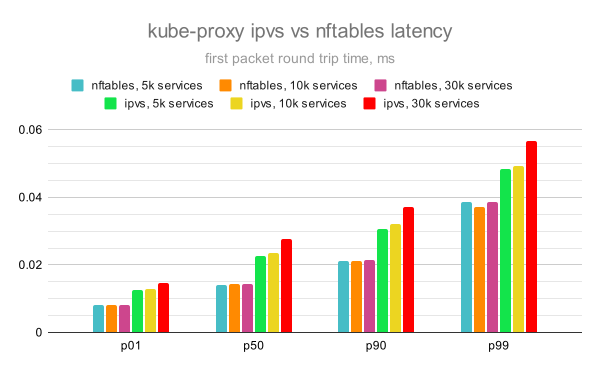
(Taller bars represent longer latency. The "p50" group is the average
connection establishment latency. Note that even the largest numbers
in this graph are quite tiny; the point is not to claim that
nftables is (noticeably) faster than ipvs, just to show that,
unlike iptables, it's not slower.)
Switching is as easy as changing the kube-proxy configuration and
restarting kube-proxy. For example, in clusters deployed via kubeadm,
change mode: ipvs to mode: nftables in the kube-proxy ConfigMap
and then restart the kube-proxy pods, as described in the
documentation on reconfiguring a kubeadm cluster. (If you are
overriding other ipvs-specific kube-proxy configuration, you will
also need to change those options to the corresponding nftables
ones.)
Switching to iptables: "It's Not As Slow As You Think!"
If you can't switch to nftables, either because you are on an older
version of Kubernetes, or because your cluster runs on an older Linux
distribution that isn't new enough to support the nftables backend,
you may be able to just switch to the iptables backend, which has
improved greatly since the original creation of the ipvs backend in
2017:
-
The generated ruleset has been optimized to remove redundant and irrelevant rules (#57461, #60306, #96959, #108251), reducing data plane latency.
-
The code that generates the ruleset has been optimized to do fewer allocations, and to avoid unnecessarily recomputing the same information multiple times (#65755, #65902, #67948, #85617, #90103, #97238), reducing CPU and memory usage when resyncing.
-
Rather than doing “check the current state of the rules, then update them to the new state”,
iptableskube-proxy now does “assume the current state is correct, update to the new state based on that assumption, and only explicitly check the current state if that update fails”. This greatly improves the resyncing speed, because it turns out that even reading the iptables ruleset is extremely slow in large clusters (#81517, #110334, #114181). -
To the extent possible within the constraints of the iptables APIs, kube-proxy’s iptables backend now only updates iptables rules for services/endpoints that have changed since the last sync, rather than rewriting the entire ruleset every time (#110268 / KEP-3453).
The net result of this is that the iptables backend of 2026, while
still not as good as the ipvs backend, is at least much better
than the iptables backend of 2017 was, and many people who found
iptables unusable in the past would not have problems with it now.
As with switching to nftables, switching to iptables is mostly
just a matter of updating your kube-proxy configuration, although for
technical reasons, in this case we recommend that you reboot each node
after changing the kube-proxy configuration, rather than merely
restarting kube-proxy.
Learn more
-
KEP-5495 gives the full timeline and plan for kube-proxy IPVS deprecation.
-
The blog post "NFTables mode for kube-proxy" has more information about
nftablesmode and its performance relative toipvsandiptables.